
The Four Dimensions, Decoded
What UNESCO actually means by “AI literacy.”
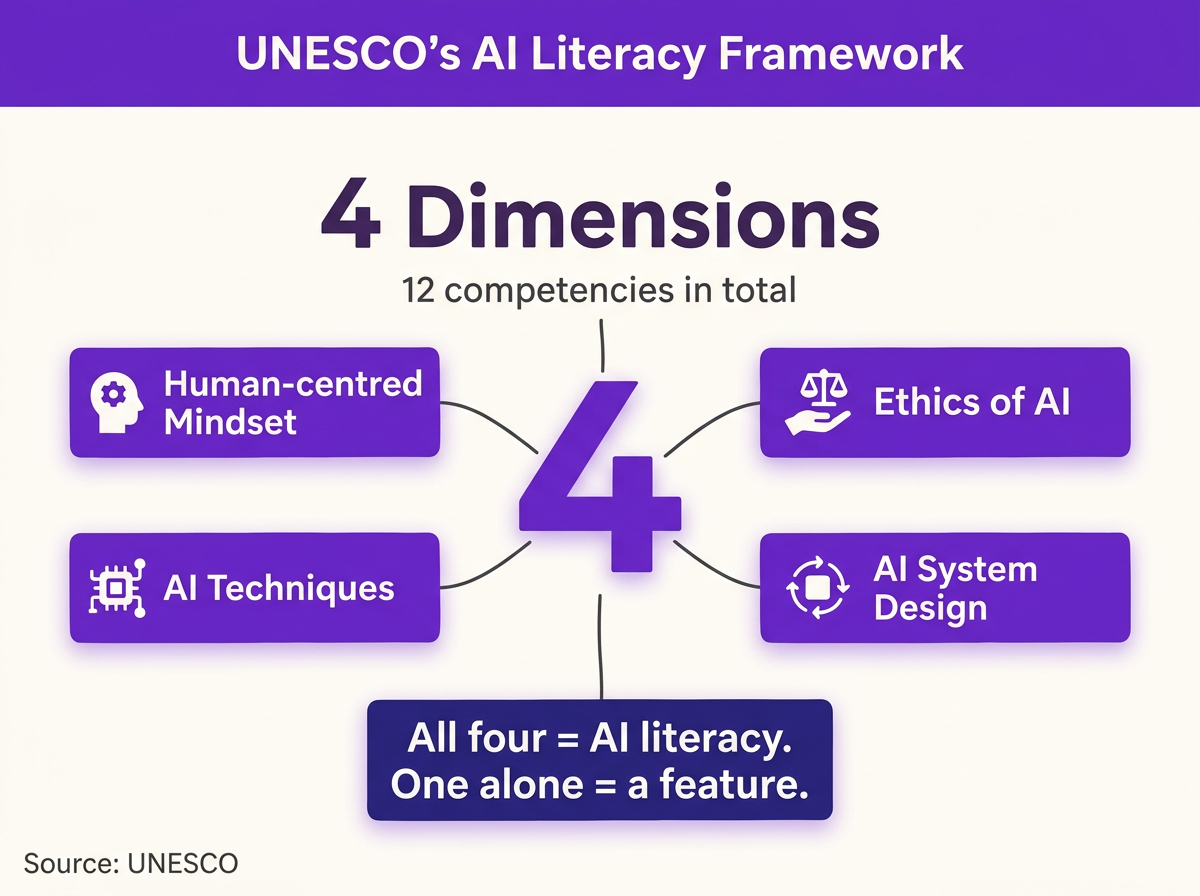
Ask ten educators what “AI literacy” means and you'll get ten answers. UNESCO settled it: four dimensions that together define a genuinely AI-literate student. Cover one and you've built a feature, not literacy.

Ask ten educators what "AI literacy" means and you will get ten different answers. Some will say coding. Some will say understanding how algorithms work. Some will say digital citizenship. All of them are partly right — and that is precisely the problem. A phrase that means everything means nothing, which makes it very easy to sell, and very hard to deliver.
UNESCO resolved this ambiguity. In September 2024, after international consultation across its member states, it published the AI Competency Framework for Students. The framework names four dimensions that together define what it means for a student to be genuinely AI-literate. Not competent at one slice. Literate.
Four dimensions. If a program covers one, it's not literacy — it's a feature.
Here is what each dimension actually means, and why dropping any one of them leaves a hole.
Dimension 1: Human-Centred Mindset
This dimension is about orientation, not skill. A student with a human-centred mindset asks, before touching any tool: who does this affect, and how? They understand that AI systems are built by people, carry the assumptions of those people, and serve — or fail — real human beings.
In practice this shows up as: noticing when an AI recommendation seems off; questioning whether a system's "efficiency" is efficient for everyone; resisting the instinct to defer to a machine just because it sounds confident.
It is the dimension most at risk of being quietly dropped from a curriculum. It generates no demo-able output. It cannot be measured in a leaderboard. But without it, the other three dimensions produce technically capable students who have no instinct to pause.
Dimension 2: Ethics of AI
UNESCO distinguishes this from the mindset dimension deliberately. Mindset is about disposition; ethics is about reasoning. A student working in this dimension learns to identify real tradeoffs — privacy against convenience, accuracy against fairness — and to apply structured thinking to them, not just express a feeling.
This is the dimension that connects most directly to citizenship. When a student asks why a hiring algorithm might be biased, or what data a voice assistant stores, they are doing ethics of AI. Not abstractly — concretely, against specific systems they encounter.
The AI4K12 Five Big Ideas — the parallel US framework jointly developed by AAAI and CSTA since 2018 — places "Societal Impact" as its fifth and capstone idea for exactly this reason: technical fluency without ethical reasoning is incomplete preparation.
Dimension 3: AI Techniques and Applications
Here is where most edtech products live. This dimension covers how AI systems actually work: what machine learning is, how a model is trained, what a dataset does, why an image classifier fails on unusual inputs. It is the conceptual engine room.
It matters enormously. A student who understands training data can recognize why a translation tool struggles with minority languages. A student who understands pattern recognition understands why a medical AI still needs a doctor.
But notice: this is one of four. A program that teaches only this dimension is teaching technical awareness, not literacy. It is the difference between knowing how an engine works and knowing how to drive — useful, but incomplete.
Dimension 4: AI System Design
The fourth dimension is the creative and critical counterpart to the third. It asks students not just to understand AI systems but to think about building them: what choices get made at design time, who bears the consequences of those choices, and what alternatives exist.
This is where the framework's three progression levels — Understand, Apply, Create — become most visible. A student at the Understand level can explain what a recommendation system does. At Apply, they can configure or use one responsibly. At Create, they are making design decisions and defending them.
UNESCO's full framework maps all 12 competencies (three per dimension) across these three levels. Each cell — dimension times level — represents a concrete, teachable objective. That structure is what makes it a rubric, not a wish list.
Using This as a Checklist
When a parent, a board member, or a procurement officer evaluates any AI literacy program, these four dimensions are the right lens. Ask specifically:
- Does the program build ethical reasoning, not just ethical awareness?
- Does it develop a human-centred disposition alongside technical skill?
- Does it progress students from understanding to applying to creating — or does it stay at the understanding level throughout?
- Does it treat all four dimensions as co-equal, or does it treat three as enrichment around a technical core?
No single answer disqualifies a program. But a program that cannot answer these questions has not thought them through. That is useful information. Digital Codi's standards alignment is designed to be auditable against this exact checklist — the curriculum maps onto all four UNESCO dimensions and the full Understand-to-Create progression arc, which means an administrator can trace any learning activity back to a specific dimension and level.
Digital Codi, a K-6 AI literacy platform designed for students aged 8–12, structures its curriculum around seven learning streams: Foundations, Data Science, Machine Learning, Computer Vision, Language AI, Ethics, and Builders Lab. Those seven streams are designed to align with all four UNESCO dimensions across the full Understand-to-Create arc. The Ethics stream addresses Dimensions 1 and 2 directly; the technical streams (Machine Learning, Computer Vision, Language AI) work through Dimension 3; Builders Lab is where students exercise Dimension 4 through capstone project design, portfolio defense, and the "Build / Judge / Refuse" test that asks them to evaluate every tool they create. The alignment with UNESCO's framework is not a claim added to a marketing deck after the fact; it is the underlying architecture of the curriculum. For a procurement officer running the four-dimension checklist, that mapping is worth requesting in writing from any vendor — Digital Codi included.
The Point of the Framework
UNESCO did not publish this framework to generate paperwork. It published it because "AI literacy" has become a phrase that can mean almost anything — and almost anything is not good enough when the question is whether students are prepared to live and work alongside systems that are making increasingly consequential decisions.
Four dimensions. Twelve competencies. Three levels. That is the rubric. Any program that covers one or two of these dimensions is building a feature, not literacy. The distinction matters — for students, for schools, and for the decisions administrators make on their behalf.
Sources Cited
- UNESCO AI Competency Framework for Students — retrieved 2026-05-31
- UNESCO AI Competency Framework for Students (full document) — retrieved 2026-05-31
- AI4K12 — Five Big Ideas in AI — retrieved 2026-05-31