
The Three-Word Test for Any AI Program
Build, Judge, Refuse — skip one and it isn't literacy.
A glossy AI-program proposal lands on an administrator's desk. Before the budget line, ask a sharper question: can children build with AI, judge whether to trust it, and refuse it when human judgment should win? Three verbs — skip one and it isn't literacy.
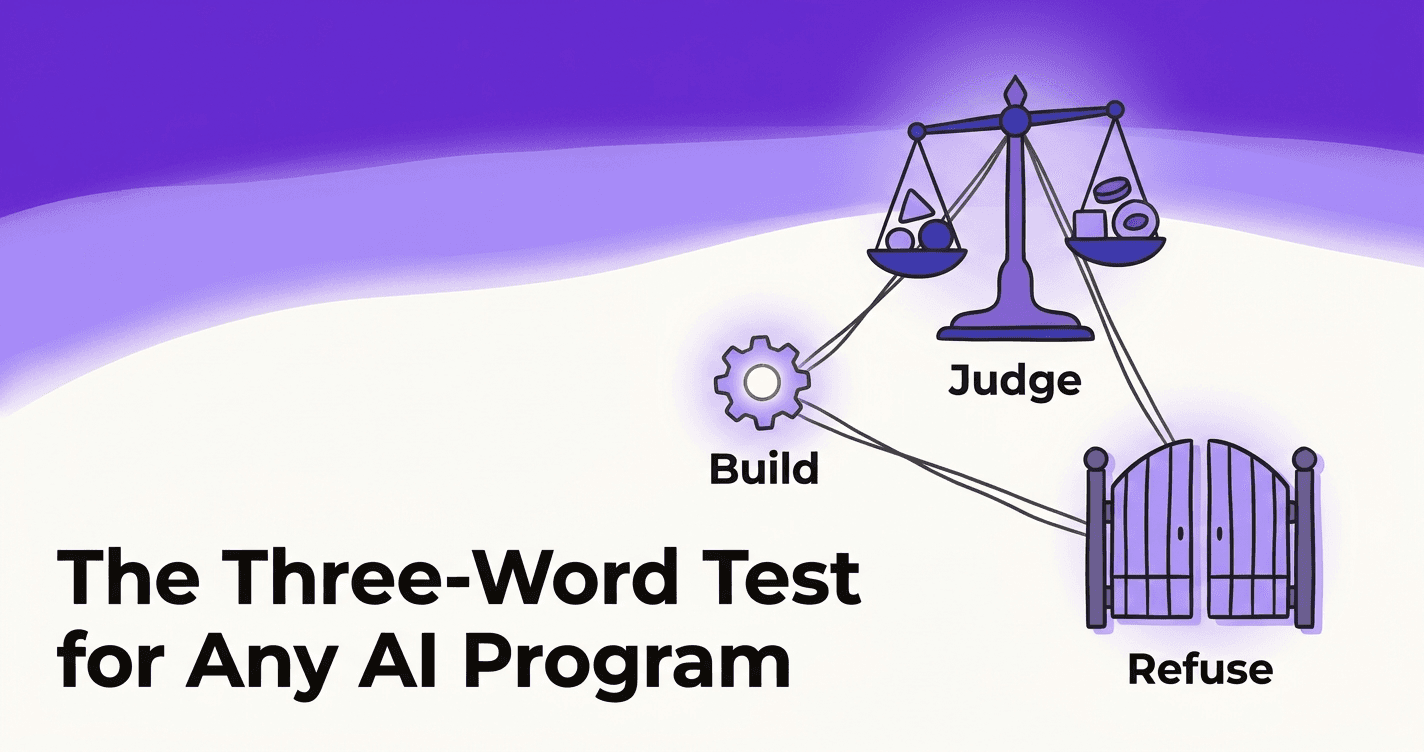
A school administrator receives a glossy proposal for an AI literacy program. The vendor promises "21st-century skills," "future-ready learners," and a dashboard full of engagement metrics. Before committing a budget line, the administrator needs a sharper question than "Does this look impressive?"
Here is one that works: Can children using this program build something with AI, judge whether an AI output is trustworthy, and refuse the tool when human judgment should win?
Three verbs. Any program that passes all three is teaching literacy. Any program that skips one — no matter how polished the interface — is teaching something else.
Why Three Verbs, Not One
The word "literacy" gets stretched so thin it sometimes means nothing at all. Reading literacy means you can decode words, understand what they say, and choose not to read something that is misleading or harmful. The same three-part structure maps cleanly to AI.
A child who can only consume AI outputs is not literate — they are a passive user. A child who can only produce AI outputs is not literate either — they are a skilled operator without critical distance. Literacy requires the full range: making, evaluating, and stopping when stopping is right.
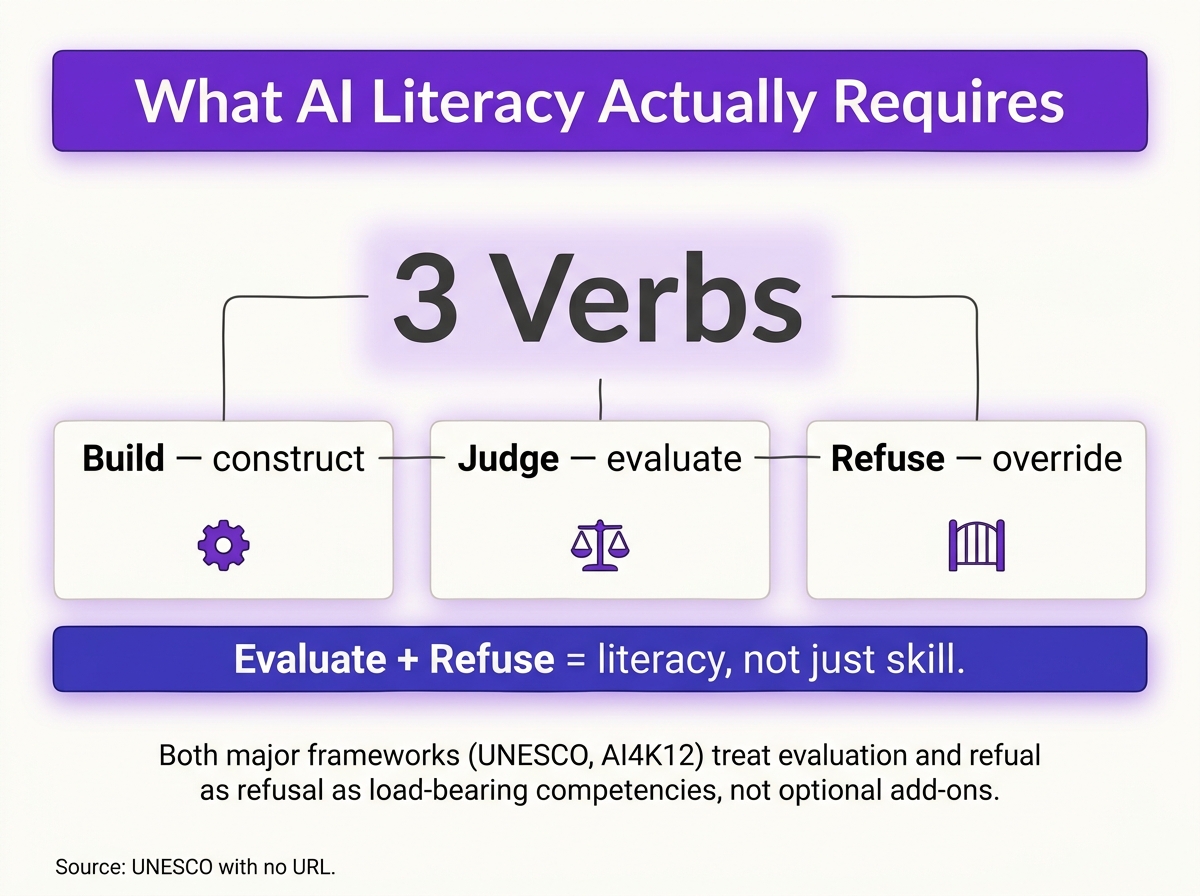
The UNESCO AI Competency Framework for Students, published in 2024, organizes twelve competencies across four dimensions and three progression levels — essentially a map from basic awareness to confident, ethical creation. What is notable is that the framework treats critical evaluation and ethical responsibility as load-bearing competencies, not electives bolted onto the end. Build, judge, and refuse are not three separate modules. They are woven through every level of the progression.
The AI4K12 initiative, which frames K-12 AI education around Five Big Ideas — Perception, Representation and Reasoning, Learning, Natural Interaction, and Societal Impact — makes the same structural argument from a different angle. Societal Impact, the fifth idea, is not an afterthought. It sits at the same level as the technical concepts, because understanding when and whether to deploy AI is as important as understanding how it works.
Both frameworks are pointing at the same thing. An AI-literate person is not just someone who can use AI tools. They are someone who understands what is happening, can evaluate what they get, and has the agency to walk away.
Build: More Than Clicking Buttons
"Build" does not mean coding from scratch. For an eight-year-old, building might mean training a simple image classifier, setting the parameters on a recommendation filter, or constructing a prompt that gets a useful result instead of a generic one. The point is active construction — the learner is doing something to the AI, not just receiving something from it.
Programs that only show children polished AI outputs are skipping this verb. They are teaching appreciation, not literacy. Appreciation is fine, but it is not the goal.
Judge: The Skill Most Programs Underserve
Most programs that include evaluation focus on accuracy: "Was the AI right or wrong?" That is a start, but a narrow one.
Judging an AI output well means asking several questions at once: Is the information accurate? Is the confidence the AI expresses warranted? Does the output reflect a bias in the training data? Is this the right tool for this question, or did I reach for it out of habit?
This kind of layered evaluation is harder to teach than a checklist, and harder to measure than a quiz score. It requires repeated practice with real outputs — not constructed examples where the "wrong" answer is obvious. Programs that skip this depth are producing children who can spot a factual error but cannot detect a subtly misleading framing. That gap matters more as the outputs get more sophisticated.
Refuse: The Most-Skipped, Most Important Verb
This is the one most programs leave out entirely.
"Refuse" means recognizing situations where the right answer is to not use AI at all — or to override what it produces. A child comforting a grieving friend should not reach for a chatbot to generate the words. A student working through a hard math problem should not delegate the reasoning to an AI before they have genuinely tried. A judgment call about fairness that involves real people should not be outsourced to a model trained on historical data that encodes historical inequity.
Teaching refusal is not anti-AI. It is the opposite of anti-AI. It is what distinguishes a tool-user with judgment from a tool-user without it. An AI-literate child knows when AI helps and when it gets in the way. That is a harder skill than using the tool, and a more important one.
Applying the Test
The three-word test is portable. Use it on a classroom activity, a homework app, a school software license, or a full curriculum proposal. For each, ask:
- Build: Does this ask learners to actively construct or configure something with AI, or just receive its output?
- Judge: Does this require learners to evaluate AI outputs critically — for accuracy, bias, and appropriateness — not just check a single correct answer?
- Refuse: Does this give learners explicit practice in situations where the right move is to not use AI, or to override what it produces?
If the answer to any of those three is "no," you have identified a gap. That does not necessarily disqualify a program — a focused tool can do one thing well — but it tells you what it is missing and what you need to supplement.
Build, judge, refuse. If a program skips one, it's not teaching literacy.
For parents, the test translates to a simpler question to ask a teacher or a vendor: When does your program teach my child to say no to the AI? If the answer is vague or surprised, that tells you something.
Digital Codi's curriculum is built around this three-verb framework. Every learning stream — from Foundations through the Builders Lab — includes activities that require learners to construct, evaluate, and decline. The "Build / Judge / Refuse" test is not a marketing phrase for Digital Codi; it is the design specification that the entire Six Rungs learning arc is held against. A program that earns all three verbs is teaching AI literacy in the full sense. That is the standard worth holding.
Sources Cited
- UNESCO AI Competency Framework for Students — retrieved 2026-05-31
- AI4K12 Five Big Ideas in AI Poster — retrieved 2026-05-31